
Explore More Academic Programs
- Anthropology
- Art
- Asian Studies
- Biology
- Chemistry & Biochemistry
- Chinese Program
- Classics
- Comparative Literature
- Department of Chinese, German, Italian, Japanese and Russian Studies
- Economics & Business
- Education
- English Department
- Environmental Studies and Science
- Feminist & Gender Studies
- Film and Media Studies
- French
- Geology
- German Studies
- History
- Human Biology and Kinesiology
- Italian Program
- Japanese Program
- Mathematics & Computer Science
- Molecular Biology
- Music
- Neuroscience
- Organismal Biology & Ecology
- Philosophy
- Physics
- Political Science
- Psychology
- Race, Ethnicity, and Migration Studies
- Religion
- Russian & Eurasian Studies
- Sociology
- Southwest Studies
- Spanish & Portuguese
- Theatre and Dance
Molecular Biology
Molecular Biology on the Block
MB201: Laboratory in Molecular and Cellular Biology and Genetics
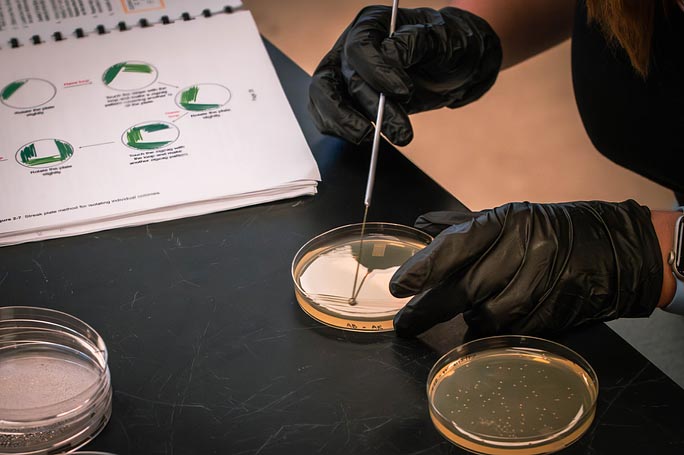
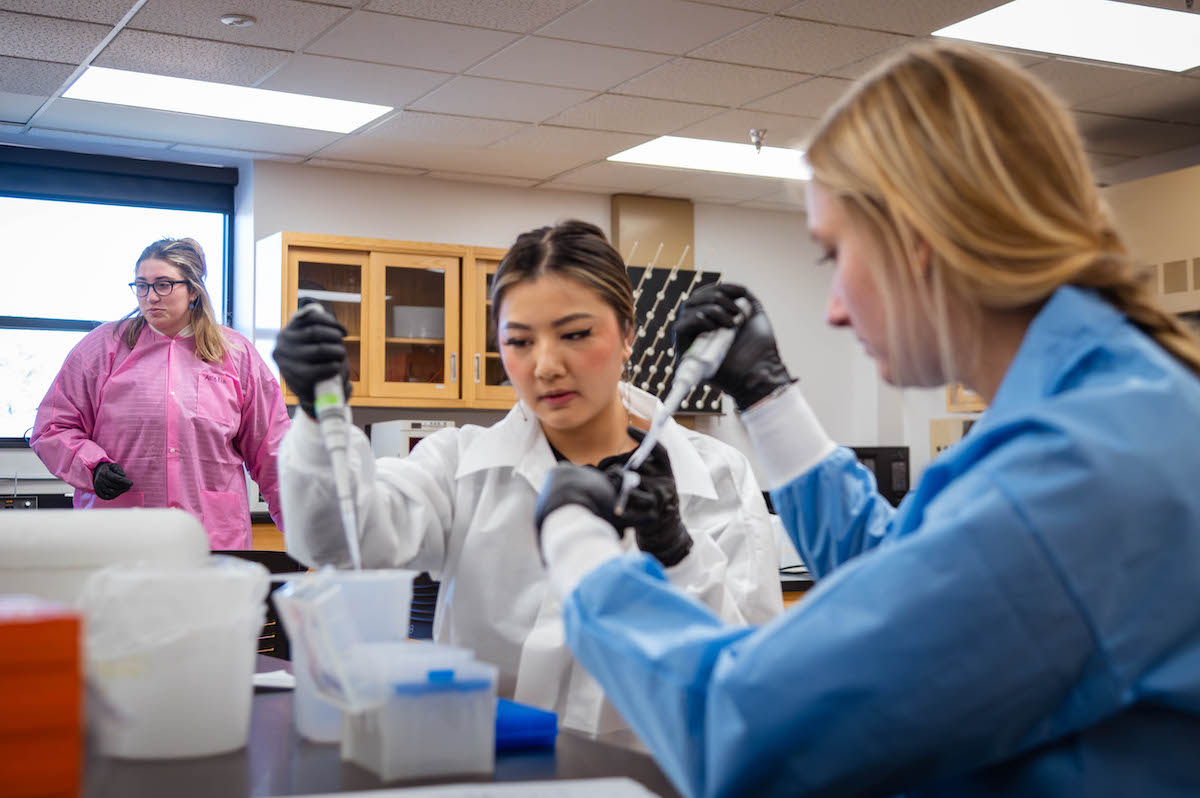
In this course, students learn techniques common in contemporary genetics, cell biology, and molecular biology research. They are also introduced to research ethics. The course focuses on skills that are commonly used in research labs to prepare students to be able to take the next step into research fields. This is a lab-intensive course taken by all MB majors and minors but also is popular for students in several other majors such as Organismal Biology and Ecology, Neuroscience, and Biochemistry.

MB375 Lab in Advanced Cell Biology
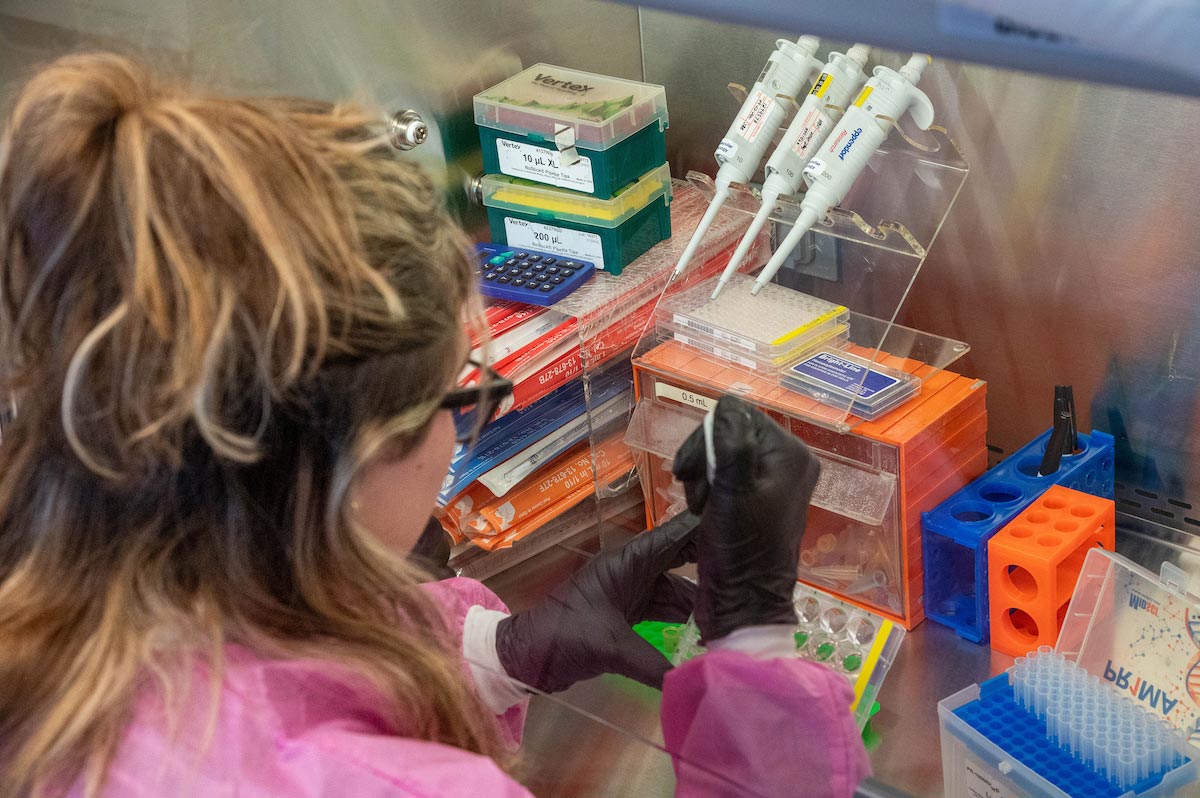
This is a laboratory-intensive, inquiry-based course that focuses on techniques in cell biology as well as modern molecular biology techniques. The course emphasizes experimental design, data gathering and analysis, and technical science writing. Students study techniques such as mammalian cell culture, flow cytometry, quantitative PCR (qPCR), molecular cloning, RNA interference, proliferation assays, and cell-cycle analysis. Course topics include cellular signaling, cellular metabolism, phenotypic analysis, and analysis of gene expression.
This is an elective course taken by mostly junior or senior MB majors, but may also include OBE, Neuro, or Biochem majors. In this class, students use more specialized equipment and learn more complex data analyses.

MB399: Mentored Research in Molecular Biology
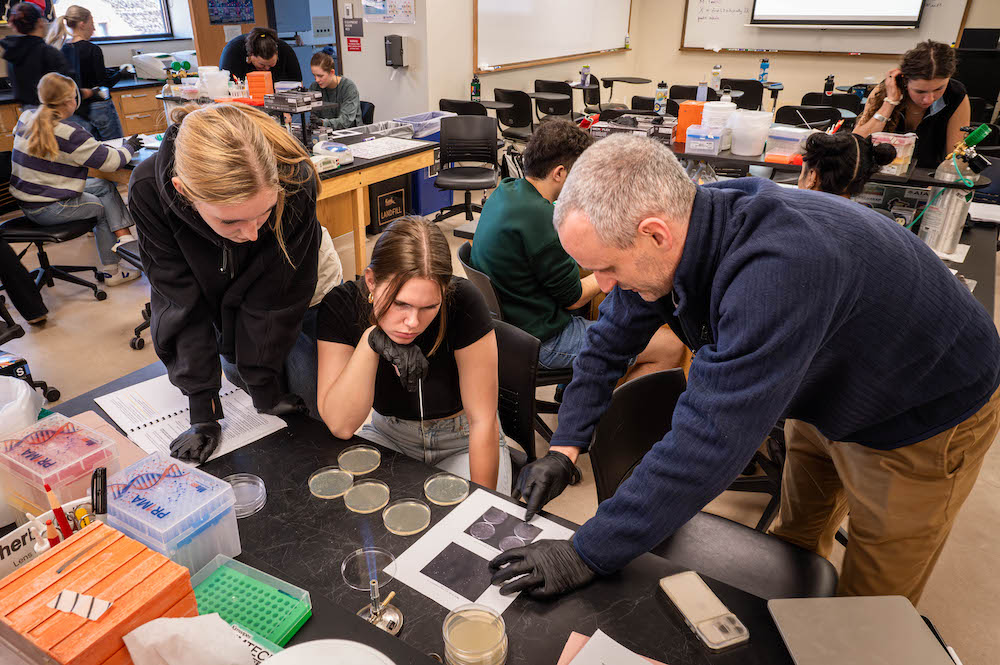
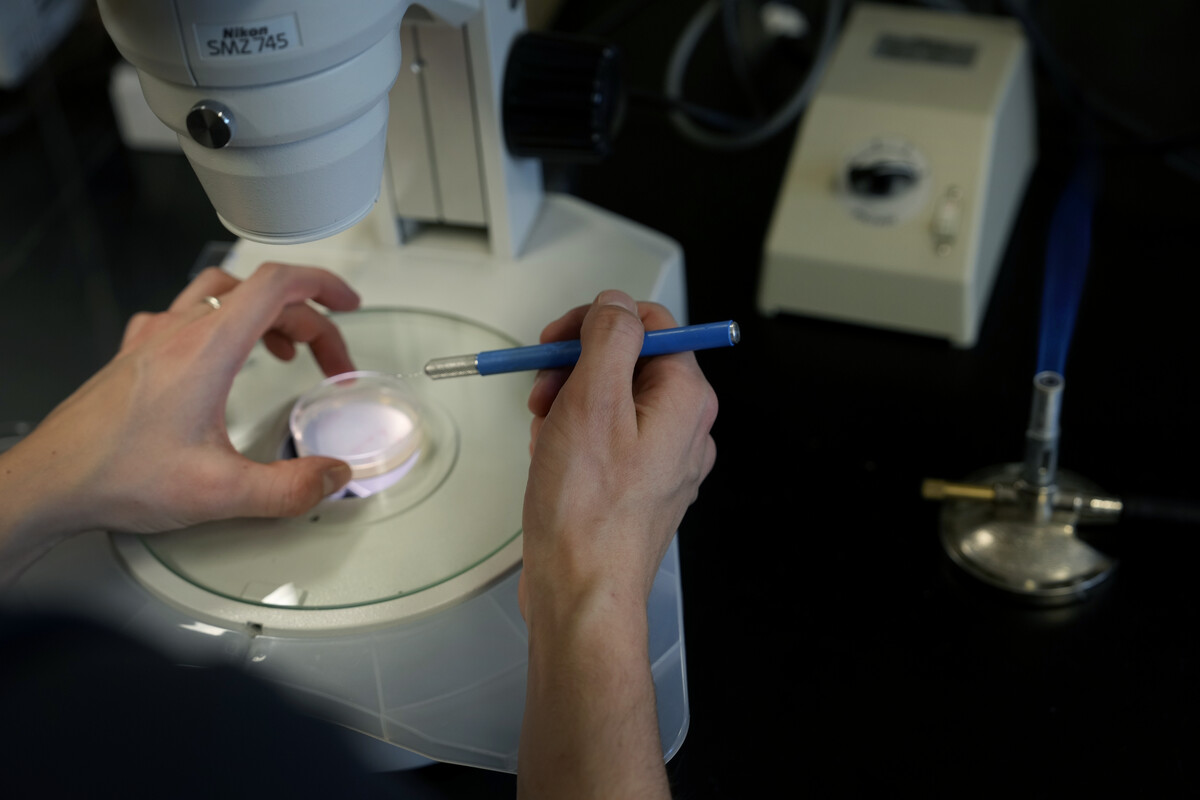
This laboratory-intensive experience for course credit (1 unit) focuses on mentored research projects based on laboratory investigation, using techniques or concepts introduced in the Molecular Biology core curriculum. Each faculty member in the department conducts research in their own area of specialization and focuses on different research questions. In this course, small groups of students collaborate and contribute to a professor’s research project. Students may use fluorescence microscopy, genetic screening, genome editing, recombinant DNA technology, and other methodologies during their research.
Students may also conduct mentored research for course credit in an extended format over four blocks under the course designation MB397 Mentored Research in Molecular Biology Alternative Format (0.5 units). After completing MB397 or MB399, students may continue on a mentored research project for credit with MB498 Advanced Mentored Research in Molecular Biology. Finally, senior Molecular Biology majors who have dedicated substantial time to a research project may elect to write up and present their work as a senior thesis in MB499 Senior Thesis in Molecular Biology (1 unit).
Featured Alumni
R. Anthony Rojas Chavez
Pronouns: he/him
Graduation year: 2019
Hometown: Lima, Peru
Currently living in: Iowa City, IA
Current occupation: Graduate Student
What was your experience at CC like as a Molecular Biology major?
My experience in the Molecular Biology program provided me with a strong foundation in biological sciences. I had the opportunity to engage in hands-on laboratory work and conduct research projects. The small class sizes and close interaction with professors and staff were particularly valuable, fostering an open and collaborative learning environment.
Yuzhu "Judy" Cheng
Pronouns: She/her/hers
Graduation year: 2021
Hometown: Tianjin, China
Currently living in: Aurora, CO
Current occupation: Graduate student at CU Anschutz
What was your experience at CC like as a Molecular Biology major?
My experiment at CC as a molecular biology major is immersive. Having three and half weeks to learn one subject truly focused on the learning process. I get to think about biology most of my days during a block. Also, people in the department are supportive. I had the opportunity to work with Dr. Darrell Killian in the laboratory, which truly transformed my CC experience. Although the coursework could be demanding, occasionally, I have a strong interest in the courses I took, which ultimately makes the entire experience memorable and rewarding.
David Eik
Pronouns: he/they
Graduation year: 2019
Hometown: Santa Rosa, CA
Currently living in: San Francisco, CA
Current occupation: High School Biology and Chemistry Teacher
What was your experience at CC like as a MB major?
As a MB major, I explored the living world at the molecular, genetic, and cellular level. Not only could I take fascinating classes like epigenetics, genomics, and immunology, but I gained hands-on laboratory skills through independent research. The professors in the department are excellent mentors who supported me in authoring a senior honors thesis. The department is small and close-knit. Going to a liberal arts college like CC also allowed me to dive deep into other subjects like sociology and Spanish, all while enjoying the beauty of the Rocky Mountains!
Colleen Leong
Pronouns: she/her
Graduation year: 2016
Hometown: Denver, CO
Currently living in: Denver, CO
Current occupation: Periodontist
What was your experience at CC like as a Molecular Biology major?
My experience as a Molecular Biology major at Colorado College afforded me opportunities unlike any other - offering an extended opportunity for primary research and travel abroad to present research, but also deep, on-campus exploration in the walls of Olin and Barnes. Colorado College offers a series of unique intellectual freedoms that other institutions simply cannot. Delving into the depth of scientific discovery either for an extended period of time, or, just three weeks at a time, offers flexibility and taught me skills in critical thinking that I use every day as a periodontist. I believe the faculty at Colorado College, namely Dr. Phoebe Lostroh in the Molecular Biology department, served as shining pillars of leaders in both the classroom and social spaces.
Ana Musto
Pronouns: she/her
Graduation year: 2022
Hometown: Rye, NH
Currently living in: New York, NY
Current occupation: Research Associate at Kallyope
What was your experience at CC like as an MB major?
The MB major at CC was extremely engaging. I remember taking deep dives into scientific papers in primary lit groups in Intro to Molecular and Cellular Biology. It’s unique for college freshmen to have the opportunity to discuss science critically. Also, the professors of the MB department are an invaluable resource and were always available to answer my questions and give feedback. They were also a great support system when I was trying to navigate post-grad life. I conducted C. elegans research with Dr. Killian which helped me figure out that I wanted more of a neurobiology-focused career. It was by no means an easy major, but as I progressed through the courses, the knowledge of numerous chemical and biological pathways started to build on each other. By my final year, I felt confident in my ability to understand complex biological problems and how to approach solving them.
Explore Our Programs
Molecular Biology Major
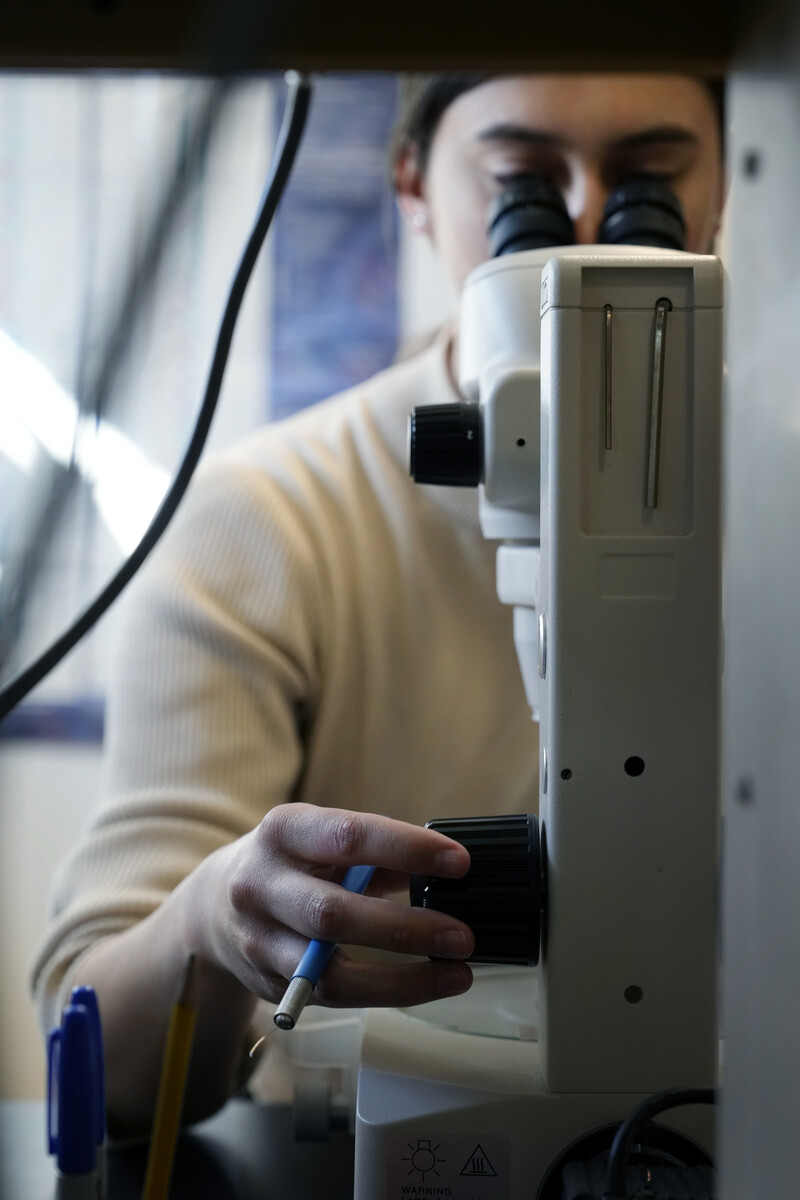
Molecular biology offers an innovative outlook by taking advantage of the Block Plan and offering courses in which students will be immersed in laboratory work, critical thinking and writing in the discipline. The Department of Molecular Biology offers a range of courses that teach students how to understand organisms on a cellular and molecular level. Our majors learn critical thinking skills in molecular biology by interpreting experiments, developing and testing hypotheses, and working with model organisms, cells, and molecules. Students majoring in molecular biology will be prepared to enter graduate programs in basic research or healthcare, and to apply the critical thinking and communication skills learned in the major to new situations, irrespective of their career goals.
Seminars
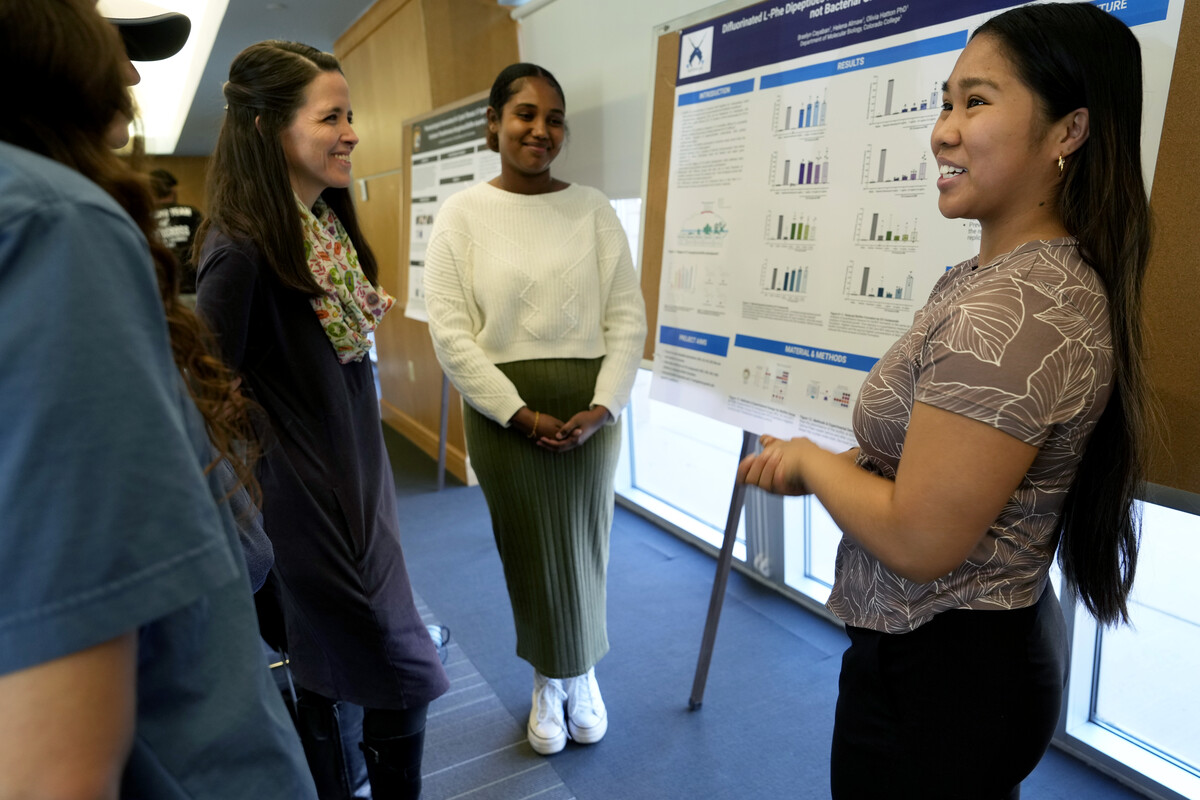
One of the most important modes of communication in the field of molecular biology is the seminar. As an important part of their education, MB majors are encouraged to attend the Molecular Biology Seminar Series. Senior MB majors are required to attend FOUR seminars as part of the Senior Capstone experience (as outlined in the MB Major’s Handbook).
MB seminars are scientific presentations given by invited guests. Often the guest speakers are experts in sub-disciplines of molecular biology that complement the expertise of CC’s MB faculty. By attending seminars regularly, students learn about research topics, questions, and techniques beyond their elective courses and research projects. Some of our seminar speakers also delve into societal and/or ethical issues that intersect with molecular biology. Students attending seminars regularly will also learn more about scientific communication and improve their own communication skills.
Each seminar ends with a question and answer session where students are encouraged to engage in scholarly discussion with seminar speakers and with each other. Seminars are free and open to the public.

Research in Molecular Biology
We encourage all Molecular Biology majors to consider getting involved in research. Research experience greatly enriches your undergraduate experience on many levels. Research enables you to put into practice what you’ve learned in the classroom and teaching labs, and gives you the opportunity to determine if a career in research is a good choice for you. You will broaden your knowledge of experimental techniques and learn how to operate research-grade instrumentation.
There are many ways to get involved in research in Molecular Biology:
- Students may do research with MB faculty for ~ 8-10 weeks over the summer as a paid Student Collaborative Research Experience.
- Students may do research with MB faculty during a block of the academic year for course credit (1 unit per block).
- Students may also do research with MB faculty during a semester in addition to their four blocks of courses as a credit-bearing experience (0.5 units per semester).
- Students who have participated in a research project (typically one summer or multiple blocks or semesters) may also write up their project and present it as a Senior Thesis in Molecular Biology.
- There are additional opportunities to gain research experience outside of CC, especially during the summers through summer undergraduate research programs at other institutions, many of which are funded by the National Science Foundation Research Experience for Undergraduates Program.
Current Stuents: For more information on research, please visit our Research Opportunities in Molecular Biology Canvas page. There you will find information about the research topics in each of the MB faculty labs, and information on how to enroll in research for course credit or how to apply for a summer research position at CC or elsewhere.

Careers in Molecular Biology
What can you do with a Molecular Biology degree? What do Molecular Biology majors do after they graduate from CC? We get questions like these frequently.
A major in Molecular Biology prepares students to think about and ask questions about life on molecular, cellular, genetic, and genomic levels. Molecular Biology majors are often curious, creative, and industrious, and develop excellent skills for problem solving, quantitative analysis, communication, and leadership. What you can do with that is vast.
Molecular Biology majors pursue many different paths, among them are:
- A career in academia: This typically involves completing a doctoral program in Molecular Biology (or a related subdiscipline). The Molecular Biology major is aligned with the required/recommended courses for many graduate programs. Academic jobs many include research, teaching, and/or administration.
- While some students elect to go directly to a graduate program from CC, some students want to gain more experience in research first through a job as a research technician in an academic lab or in industry.
- A career in research at a biotechnology or pharmaceutical company: This typically involves graduate studies (Ph.D. or M.S.) in Molecular Biology (or a related subdiscipline).
- A career in a health profession: This involves additional training in medical school, dental school, veterinary school, physician assistant school, nursing school, or another health degree. The requirements for the Molecular Biology major have significant overlap with courses that are required/recommended for many of these programs.
- A career in genetic counseling.
- A career in science education at the elementary, middle school, or high school level.
- A career in science writing or communication , which may benefit from graduate studies (such as an MS in Communication or Journalism).
- A career in consulting, patent law, or business in biotechnology or pharmaceutical companies.

The CC Department of Molecular Biology focuses on the universal properties shared by all living things, such as the inheritance and use of genetic information. Our students learn critical thinking skills in molecular biology, such as how to perform and interpret experiments and develop and test hypotheses, while communicating primary research findings about molecular biology across the whole curriculum. Students majoring in molecular biology will be prepared to enter graduate programs in research or healthcare, and to apply the critical thinking and communication skills learned in the major to new situations, irrespective of their career goals.
Contact Us
Olivia Hatton
Department Chair
ohatton@coloradocollege.edu
(719) 389-7476
Mailing Address
Department of Molecular Biology
14 E. Cache La Poudre St.
Colorado Springs, CO 80903
Address & Map